
Mobile Infrastructure Corp. (NASDAQ: BEEP)
BEEP! BEEP!

1. Introduction
Market Cap. ~$US75M
EV. ~ $US280M
BEEP is an owner-operator of parking facilities in the United States.
35 parking facilities across 18 US markets as of Q1 2026.
13,200 parking spaces
4.6 million square feet.
2. Management Strategy: A Full Turnaround
Management plans to sell $100M worth of assets (more than its entire market cap.) during the next 36 monts, for the purpose of 1) pay down outstanding debt and a line of credit which bears a 15% interest rate and 2) sell the assets at a premium to its book value and show the market that the parking assets are worth more than their accounting carrying values.
As of Q1 2026, BEEP has already exceeded $30M in sales at an average cap rate of 2%
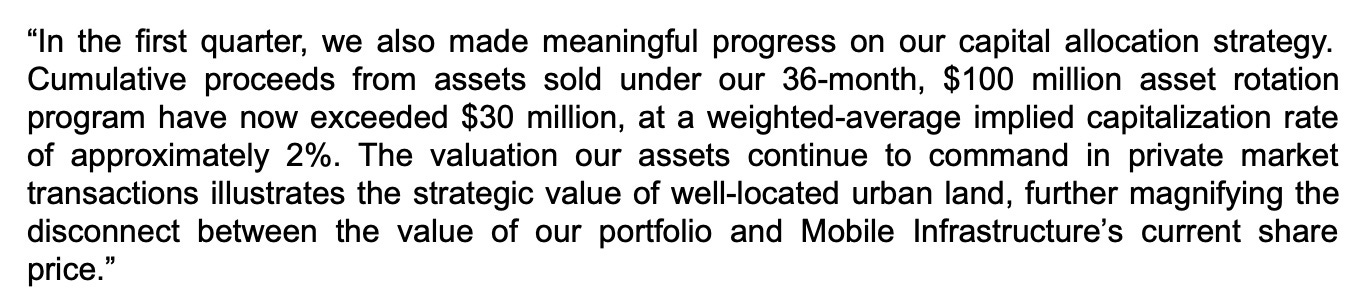
Q1 2026 report. Management explicit comments about disconnect between NAV and share price.

Honolulu asset transaction reported, Q1 2026.
The Math:
Honolulu Asset Sale Example: The Honolulu parking facility was sold for $16.5M. If we assume the average cap rate of 2% then: Net Operating Income (NOI) = Value x Cap Rate => $16.5M × 2% = $330,000 NOI.
But who wants to buy a parking facility for $16.5M that generates $330k annually in operating income?
Investors buying this assets are probably thinking about the underlying land, which in the case of downtown Honolulu is quite scarce. Parking Assets might be more valuable as a call option on urban land than as a modest income producer.

On the statement above, management is very explicit about what they want to achieve with its 36-month ‘Asset Rotation’ plan. (Proxy Statement 2025).
Overall, during Q1 2026, the company disclosed $16.5M sale proceeds from Honolulu, $8.1M mortgage debt and $4.5M Line of Credit repaid.
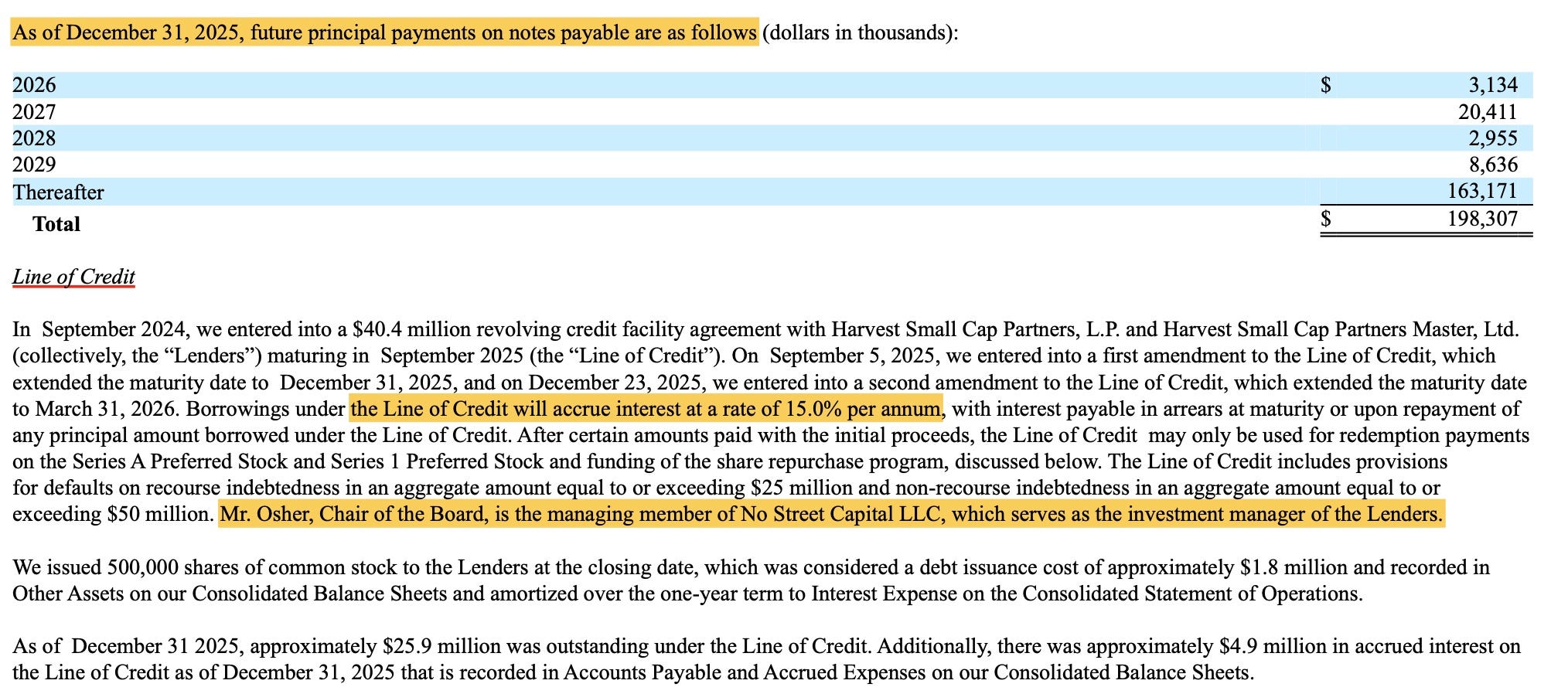
Annual Report 2025.
Interestingly, notice that who provides the expensive 15% line of credit is a company controlled by the Chair of the Board, Mr. Osher, which at the same time: "As of December 31, 2025, Mr. Osher beneficially owns directly or through HS3, Harvest Small Cap and HSCP Master, 27,043,474 shares of our Common Stock, or approximately 64.1% of the outstanding shares of our Common Stock."
As a major shareholder Mr. Osher suffers the same discount to NAV as other shareholders, while he has enormous incentive to close the valuation gap. But there’s also this nuanced situation where he benefits from both, equity ownership and lender economics.
Balance Sheet:
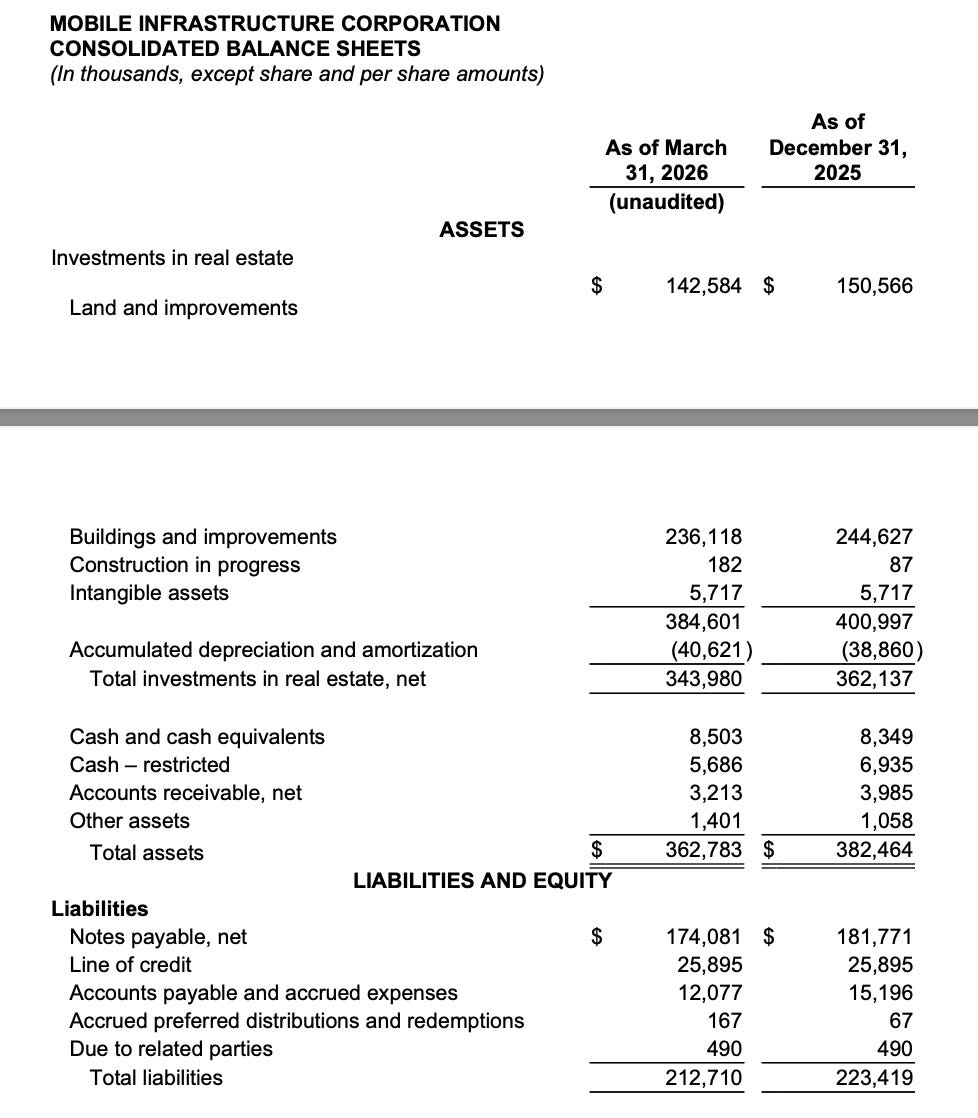
As of Q1 2026 investment in real estate, net of depreciation is $343,980M + Cash (not restricted) of $8,503M = $352,483M. Subtracting $199,976M of financial debt = $152,507M of Net Fixed Assets + Cash available. Divided by 39,3M of shares outstanding = $3.87/share. Current share price is ~$1.90 (17th jul. 2026).
And this is only the discount reflected on the balance sheet, which does not reflect the true market value the parking assets might be worth today.
Share Repurchase:
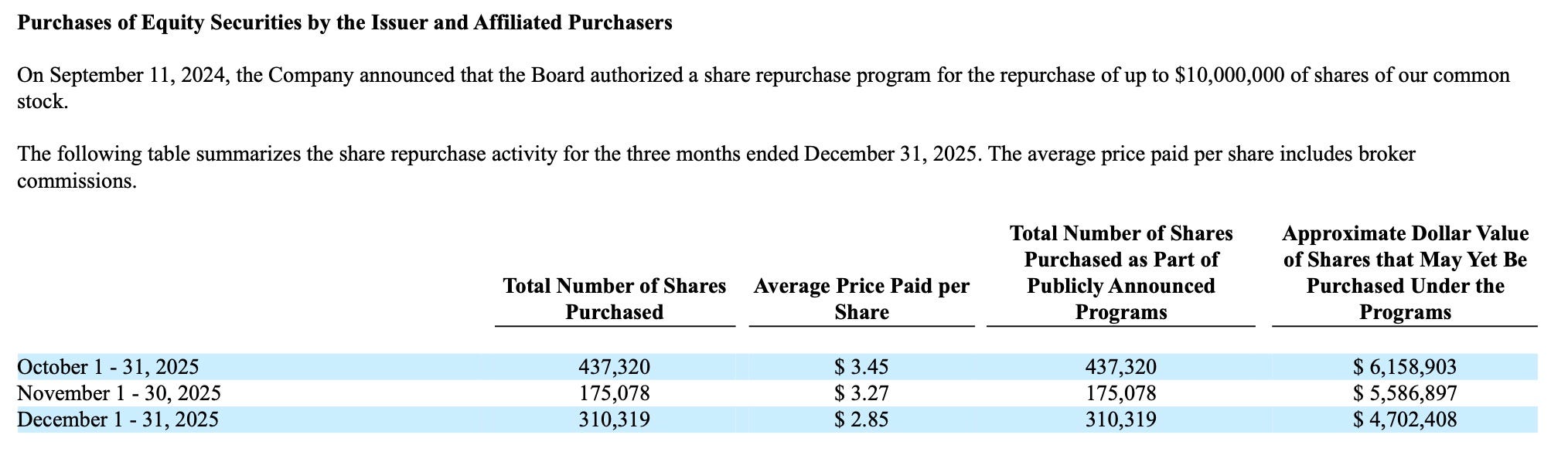
Annual Report 2025.
Still $4.7M remains for share repurchase under the 2024 repurchase program. Assuming a true NAV/share value of only 4$/share, and you can see why repurchasing shares at current market prices of 1.90$ is really accretive.
The Asset Sale + Buyback Flywheel:
Sell property at 2% cap rate.
Use part of proceeds to retire debt. (Interest expenses falls)
Use remaining cash to repurchase shares trading at 0.5x book. (Share count falls)
Remaining shareholders own a larger percentage of the portfolio.
NAV/share increases.
So BEEP’s management is paying debt which is a guaranteed low-risk return while incrementing its own ownership of the portfolio, (remember Mr.Osher is the Chairman of the Board and also the major shareholder).
3. Risks
Huge interest expenses: Q1 26 revenue was $7.9M with $5.1M in interest expenses.
15% Line of Credit: It suggests lenders view the company as higher risk.
Persistent Losses: No net profit reported yet since going public in 2023.
Operator Concentration Risk: Top 10 assets represent 68% of revenue. Most important, an operator called Metropolis Inc. which acts as operator agent or lease tenant, dependent on location, contributes 63% of revenue.
Parking Demand May Be Structurally Peaking: The investment thesis is not build on strong parking demand, nor in scarcity of parking facilities, even so, management is providing positive guidance (more on that later).
4. The U.S parking industry
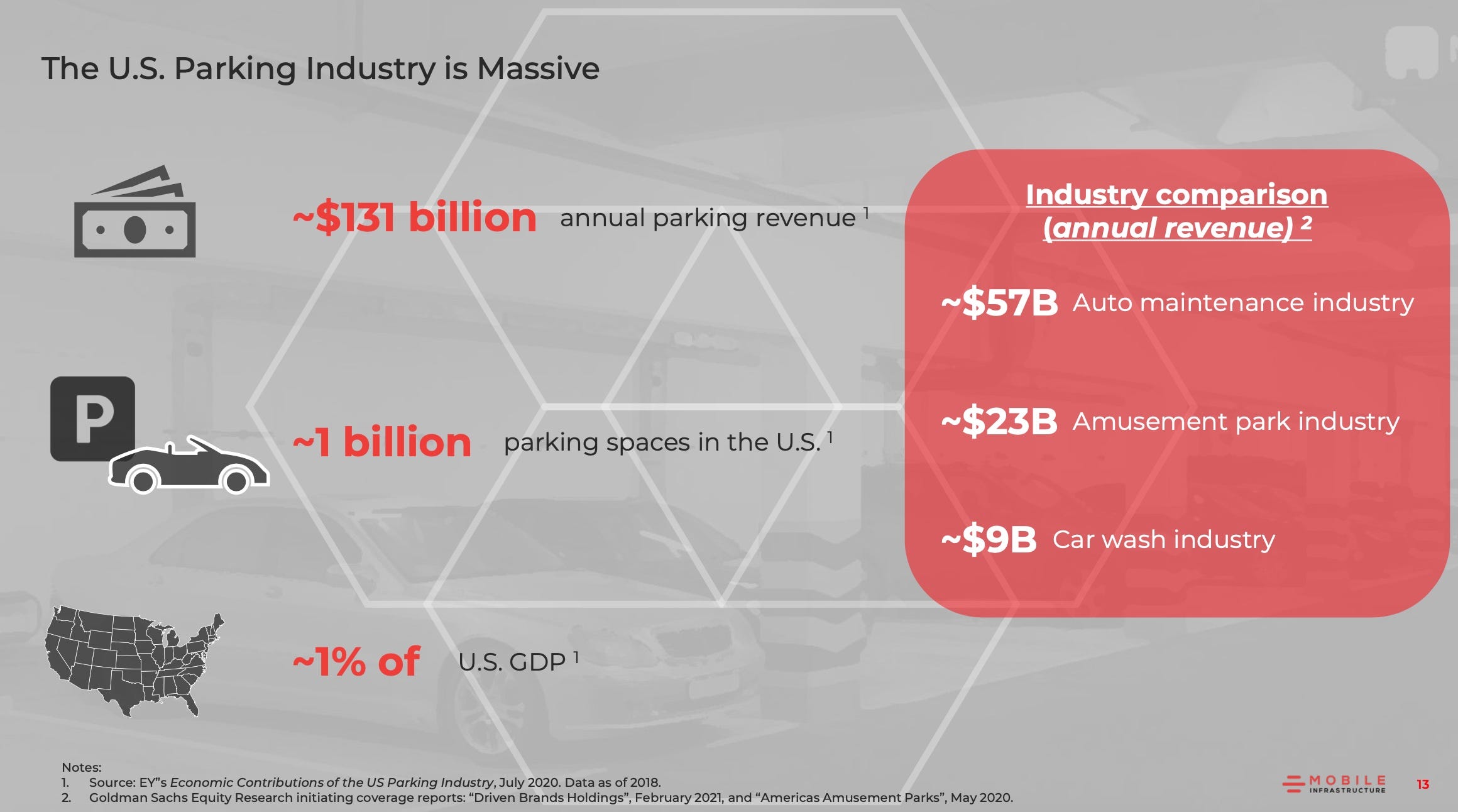
Q1 2026 presentation.
Management talks about limit growth of new supply due to land scarcity, rising development costs and zone restrictions. Furthermore, they have a positive short-term demand outlook “supported by higher residential demand and continued return-to-office momentum” (Q1 2026). The market is fragmented and M&A is possible, with mom and pop owners seeking liquidity.
For Q1 2026, BEEP same-location revenue has remained stable year-over-year, while same-location NOI increased by 4.4%. Transit volumes have grown year-over-year by 3% as several parking facilities experienced redevelopments during 2025 and are now re-opening.
For FY26, management expects revenues in the range of $35M to $38M, representing 4% growth at the midpoint over 2025 results and 8% growth on a same-location basis. While NOI is expected to be in the range from $21.5M to $23.0M, representing year-over-year growth of 7% at the midpoint, and 10% growth on a same-location basis.
This guidance does not include asset sales.
5. Conclusion
BEEP looks less like a traditional operating company and more like a discounted urban land portfolio undergoing a balance-sheet restructuring.
At 1.90$/share investors are paying roughly 50 cents on the dollar of reported book value, and potentially much less than underlying private-market NAV if recent asset sale valuations are representative.
The thesis looks quite simple: eliminate expensive debt, convert the current NAV discount into per-share value through buybacks and deleveraging, grow same-property NOI.
Thanks for reading!